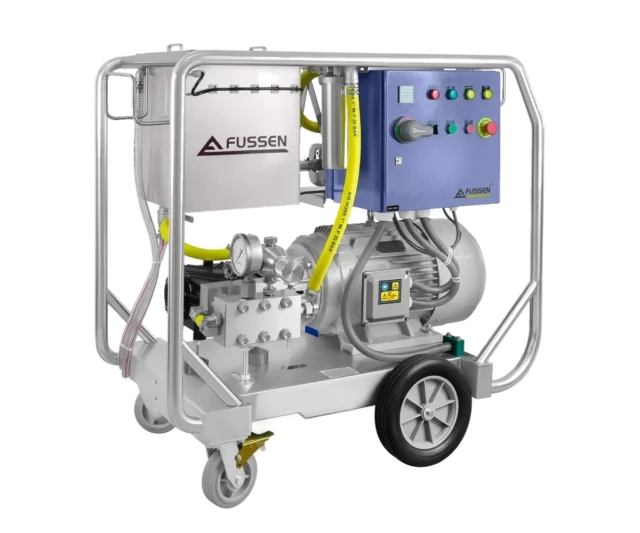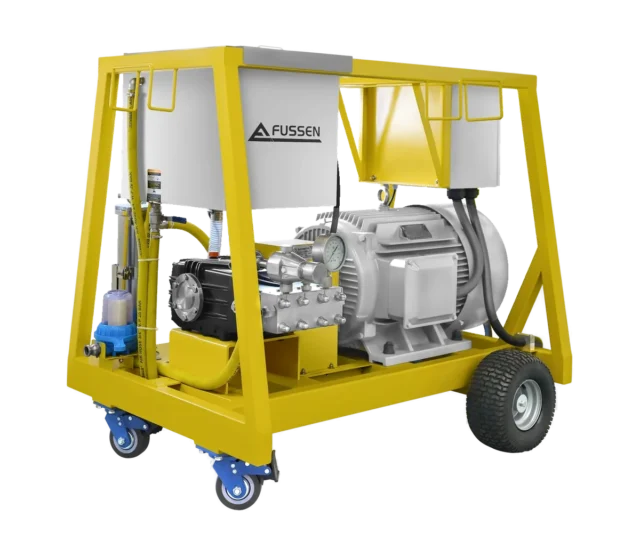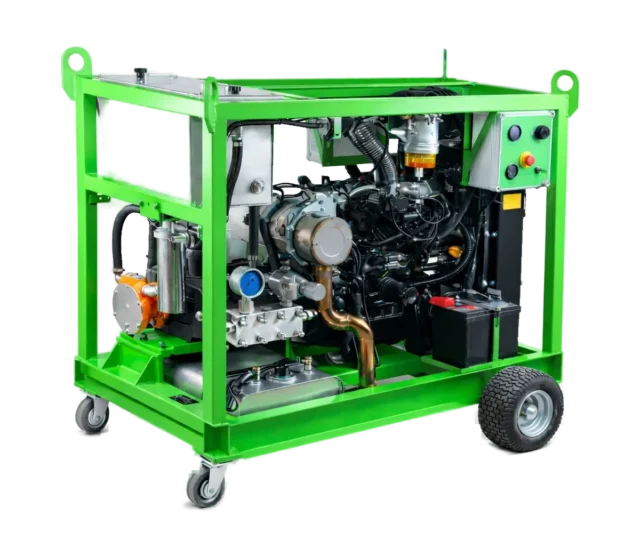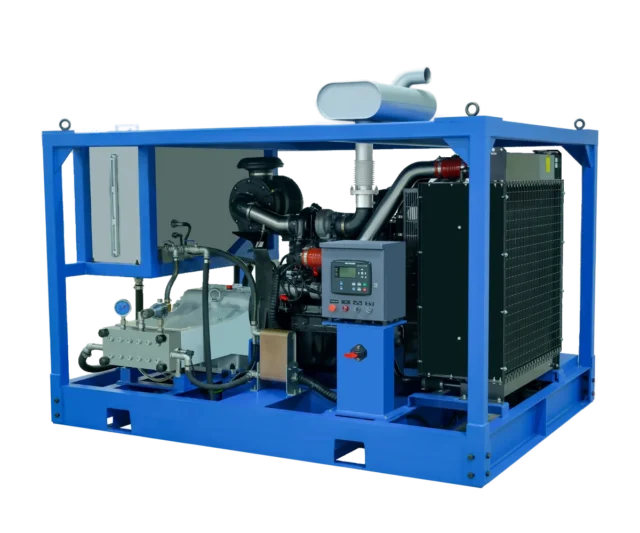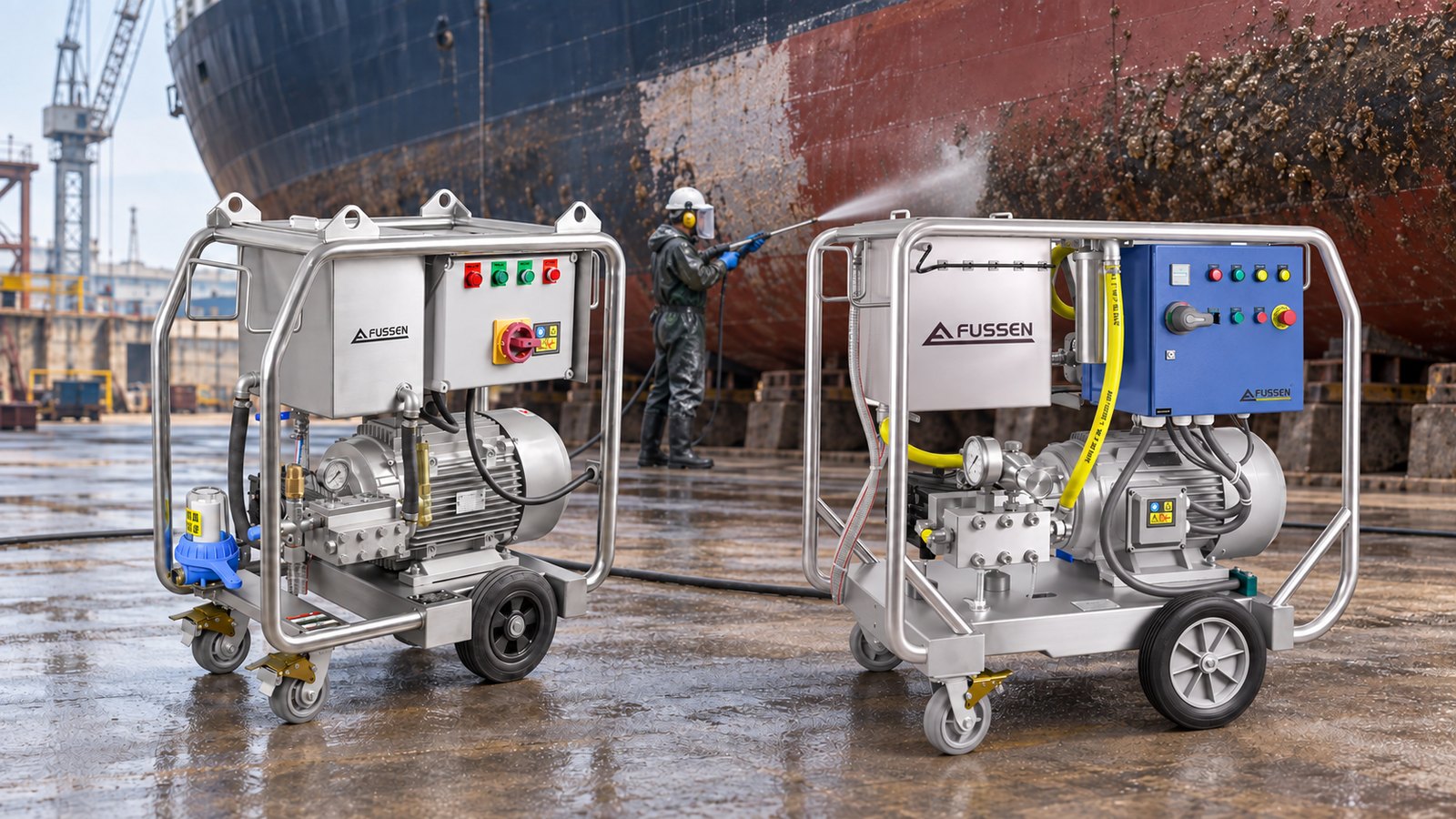
Marine cleaning ranges from washing decks to removing fouling or coatings. Define the task, coating requirements, water source and vessel or yard utilities before selecting a machine.
Separate cleaning from coating removal
A setting that removes marine growth can also damage antifouling paint. Use the coating supplier's limits and a representative trial to choose nozzle, distance, traverse speed, pressure and flow. Do not promise paint preservation from a pressure band alone.
For recoating, specify required cleanliness, salts, surface profile and flash rust. State actual operating pressure rather than relying on a broad “UHP” product label. Contain removed coatings and contaminated water according to the job requirements.
Calculate power and assess reaction force
Hydraulic power is p (bar) × Q (L/min) ÷ 600. At 500 bar and 22 L/min it is about 18.33 kW. Required shaft input is higher; at an assumed pump efficiency of 0.88 it is about 20.83 kW before additional drive losses.
For an ideal steady water jet, F (N) ≈ 0.2357 × Q (L/min) × √p (bar). This gives about 116 N at 500 bar and 22 L/min, and 183 N at 1500 bar and 20 L/min. These estimates do not prove that a lance is comfortable or safe to hold. Include transient and hose loads, stance, access and exposure time.
A foot-operated dump control provides control of the jet; it does not remove reaction force while spraying. Where the assessment or applicable rules require support, use a suitable supported or mechanised arrangement. Do not treat a cited 250 N recommendation as a universal legal limit or permission to work below it.
Specify corrosion and seal compatibility
Salt spray outside the machine and seawater inside it are different exposures. Specify frame protection and all wetted materials separately. A stainless head alone does not establish seawater suitability; grade, chlorides, temperature, crevices, valves, seals and fittings all matter.
Choose seal packs by part number, fluid, pressure and temperature. Do not rearrange low- and high-pressure seals without an approved drawing, or assume that every application above 60°C requires the same elastomer. Filtration controls particles, not dissolved salts.
Confirm onboard and yard power
Read the actual supply data: vessels and yards can differ in voltage and frequency. A change from 50 to 60 Hz may alter pump speed and flow; the pressure and power consequences depend on nozzle and control configuration. Order the motor and pump arrangement for the confirmed supply rather than assuming an onsite adjustment will suffice.
Where an engine-driven unit is appropriate, assess exhaust, noise, fuel handling and installation conditions. Ordinary equipment is not suitable for a hazardous area merely because it is used on deck.
Distinguish hot-water configurations
FHE uses electric heating; FHP and FHS use fuel-fired heating. Check continuous outlet temperature at the specified flow and inlet temperature. A fuel-fired heater in or near enclosed spaces needs a suitable installation and vessel approval; routing an exhaust pipe outside is not, by itself, a complete assessment.
Plan documentation and spare parts
Request model-specific operating instructions, parts drawings and the conformity documents required for the destination and installation. Industry membership is not a substitute for equipment approval or a delivery guarantee.
Build spares lists from the supplied pump's model, serial number and kit references. Equal drive-shaft diameters do not prove seal-kit compatibility. Confirm port delivery arrangements, storage and maintenance intervals rather than inferring them from a common series name.
Related equipment
References and product documents
BSSA: stainless steel in seawater; Safe Work Australia: high-pressure water jetting; Fussen pressure-washer catalogue
Frequently asked questions
Does a foot pedal reduce lance reaction?
No. It controls flow or unloading; the force during spraying still needs appropriate handling or mechanical support.
Can pumps with the same shaft use one seal kit?
Not necessarily. Check plunger dimensions, construction, material and the manufacturer's kit references.
Are all Fussen hot-water units diesel-heated?
No. FHE is electrically heated; FHP and FHS use fuel-fired heating. Match the configuration to the installation.

Fussen has designed and manufactured high pressure plunger pumps and industrial washers in Foshan, China since 2001. ISO 9001 / 14001 / 45001, CE and ATEX-certified, exporting to more than 60 countries.