Hot water can help remove suitable oily or heat-softened soils, but its value depends on measured cleaning time, energy demand and utilisation. A worked cost model is useful only when its assumptions remain visible.
Match heat to the soil and surface
Temperature can reduce the viscosity of some oils and soften certain fats, waxes and deposits. Results also depend on detergent formulation, contact time and surface compatibility. Do not assume all cleaning reactions double in speed with every 10°C rise or that every surfactant works best above its cloud point.
Use a trial to compare accepted cleaning results, chemical use and total time. Cold water may be sufficient for loose dirt; some coatings and adhesives respond to heat, while other surfaces can be damaged. Cleaning with hot water is not, by itself, a validated disinfection process.
Calculate continuous heating demand
For water, useful heat ≈ Q (L/min) × 4.19 × ΔT (°C) ÷ 60, in kW. Heating 15 L/min from 20°C to 80°C therefore needs about 62.85 kW delivered to the water. With an assumed fuel energy of 10 kWh/L and heater efficiency of 85%, this corresponds to about 7.39 L/h of fuel at continuous full heat.
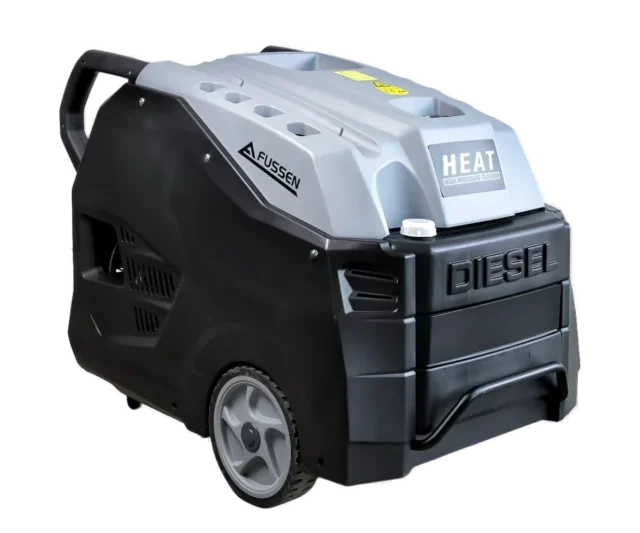
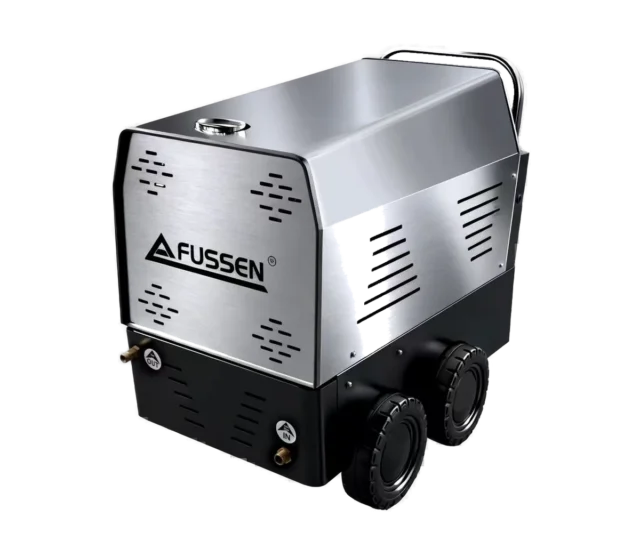
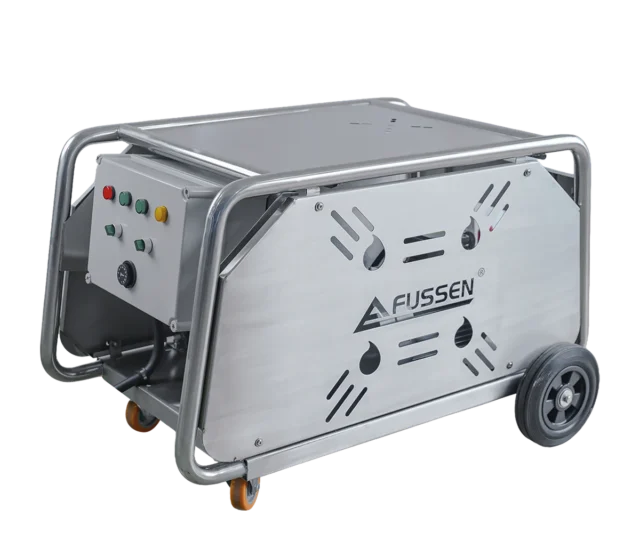
FHE uses electric heating; FHP and FHS use fuel-fired heating. The FHE catalogue lists 24, 36 and 48 kW heater options, separate from pump-motor power. The following estimates assume 20°C inlet water, continuous flow, all heater power transferred to water and no storage contribution; real heat losses reduce the result.
| Flow (L/min) | Heater (kW) | Ideal outlet (°C) |
|---|---|---|
| 15 | 24 | 42.9 |
| 15 | 36 | 54.4 |
| 15 | 48 | 65.8 |
| 18 | 24 | 39.1 |
| 18 | 36 | 48.6 |
| 18 | 48 | 58.2 |
A thermostat maximum is not a guaranteed continuous outlet temperature at full flow. Reduced flow or stored heat can change the result and must be specified separately. Size the supply for heater plus actual pump and auxiliary input.
A transparent cost scenario
Assume 2000 vehicles per year, 40 minutes per cold wash and 25 per hot wash; labour is valued at 30 currency units per hour. Assume average pump electrical input of 7.5 kW while working, electricity at 0.20/kWh, fuel at 1.20/L, and a burner consuming 6 L/h during 70% of hot-wash time. Extra purchase cost is 4000. These are illustrative inputs, not measured Fussen performance.
The fuel assumption in this cost scenario is not the continuous 60°C-rise condition calculated above. Detergent savings are assumed at 30%; replace them with trial results. The table excludes financing, taxes and residual value and assumes labour time saved has full economic value.
| Annual item / currency units | Cold water | Hot water |
|---|---|---|
| Operating hours | 1333.33 | 833.33 |
| Labour | 40000 | 25000 |
| Pump electricity | 2000 | 1250 |
| Heating fuel | 0 | 4200 |
| Detergent | 1500 | 1050 |
| Additional heater maintenance | 0 | 600 |
| Total annual cost | 43500 | 32100 |
Annual saving is 11400 and simple payback about 4.21 months under these assumptions. Doubling fuel price reduces annual saving to 7200 and extends payback to about 6.67 months.
Check low utilisation and cash savings
At only two vehicles per day for 250 days, the same model gives about 2400 annual saving and 20 months' payback, keeping the assumed 600 annual heater maintenance cost fixed. Cold-water operating time is already about 333 hours. There is therefore no justified rule that “more than 300 hours always pays back within a year”.
If staffing cost does not fall, saved labour hours may create capacity rather than cash savings. Recalculate using realised labour savings or revenue, local energy prices, measured cleaning time, maintenance and downtime. If hot water provides no time or quality benefit, extra heating cost may not be justified.
Specify installation and maintenance
Confirm inlet temperature at the pump and the ratings of components after the heater. Choose electric heating where combustion is unsuitable and adequate electrical capacity exists; fuel-fired installations need suitable combustion-air and exhaust arrangements. Follow the actual heater's scale-control, service and freeze-protection instructions rather than universal hour intervals or acid-cleaning recipes.
Related equipment
Fussen FHE · Fussen FHP · Fussen FHS
References and product documents
Fussen pressure-washer catalogue
Frequently asked questions
Does a 48 kW FHE heater give 80°C continuously at 15 L/min?
Not from a 20°C inlet under steady flow without stored heat. The ideal estimate is about 65.8°C; confirm the actual configuration and losses.
Is the four-month payback guaranteed?
No. It belongs to the stated scenario. Actual return depends on utilisation, measured time savings, prices and whether saved labour becomes an economic or cash benefit.
Is hot-water cleaning automatically disinfection?
No. A disinfection process needs validated conditions, including the relevant surface temperature, exposure time and any chemical requirements.

Fussen has designed and manufactured high pressure plunger pumps and industrial washers in Foshan, China since 2001. ISO 9001 / 14001 / 45001, CE and ATEX-certified, exporting to more than 60 countries.