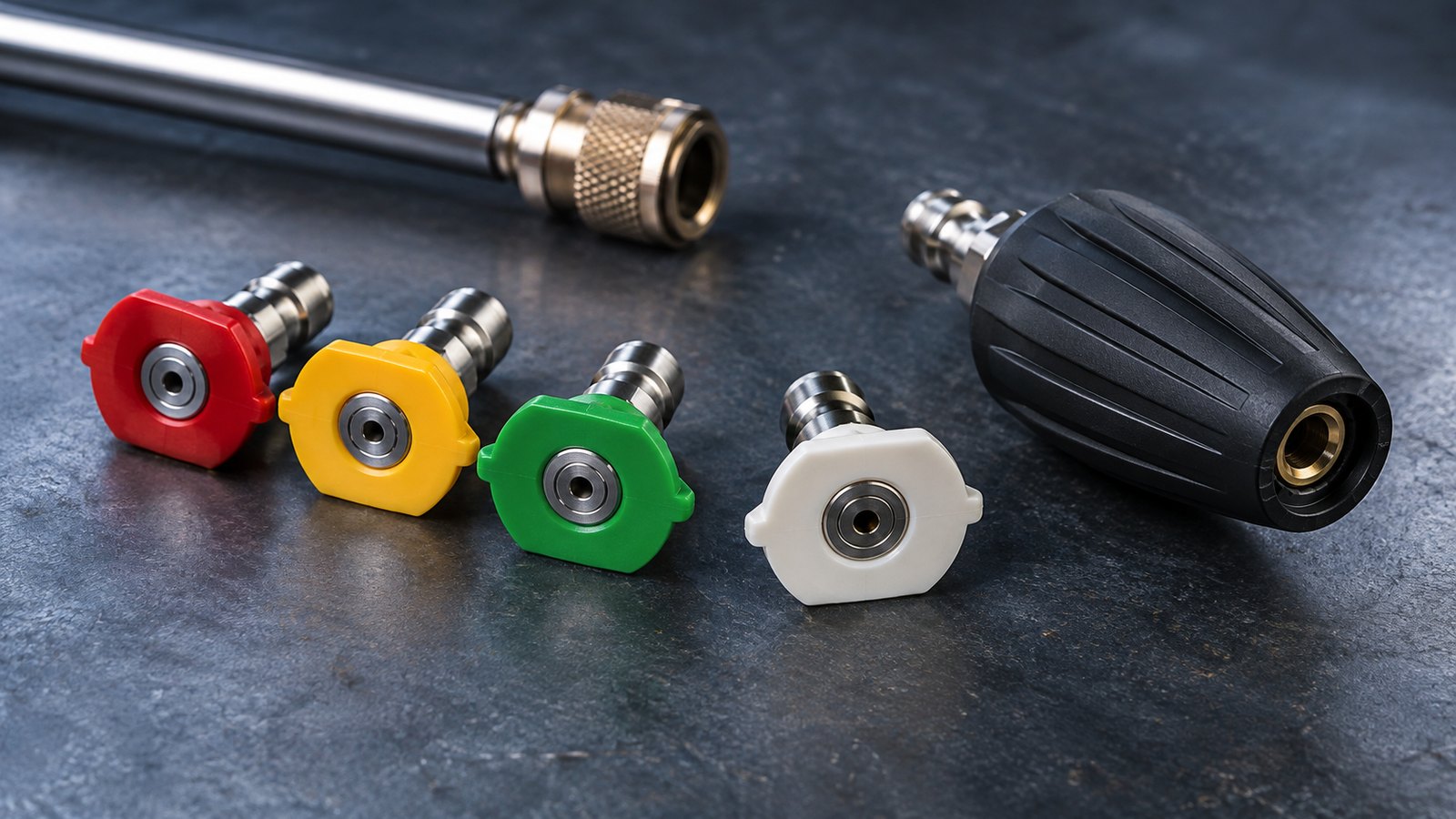
A nozzle must match the pump's delivered flow, the target pressure and the ratings of the complete system. Use its manufacturer's chart as the starting point, then check the actual operating condition.
Read the nozzle number correctly
In a common pressure-washer convention, size 05 denotes approximately 5 US gallons per minute at 4000 psi, not a 5 mm hole. Numbering can differ between nozzle families. Confirm the manufacturer's flow data, spray pattern and maximum pressure and temperature.
The following values are from the Fussen nozzle chart. Flow is in L/min; values are rounded. Treat them as selection data for the corresponding nozzle family, not as interchangeable specifications for every brand.
| Nozzle size | 100 bar (L/min) | 150 bar (L/min) | 200 bar (L/min) |
|---|---|---|---|
| 03 | 6.8 | 8.3 | 9.6 |
| 04 | 9.1 | 11.1 | 12.9 |
| 045 | 10.3 | 12.6 | 14.6 |
| 05 | 11.4 | 14.0 | 16.1 |
| 06 | 13.7 | 16.8 | 19.4 |
| 07 | 16.0 | 19.6 | 22.6 |
| 08 | 18.2 | 22.3 | 25.7 |
| 10 | 23.0 | 28.2 | 32.5 |
Use the square-root relation
For the same nozzle and approximately constant discharge coefficient, Q₂ = Q₁ × √(p₂/p₁), or p₂ = p₁ × (Q₂/Q₁)². Pressure here is the drop across the nozzle; in free discharge it is approximately its inlet gauge pressure. Allow for hose and fitting losses between pump and nozzle.
Extrapolating a chart does not increase a nozzle's pressure rating. Confirm the nozzle, gun, hose, connectors, control valves and pump are all rated for the resulting duty, and check the available shaft power.
Example: 15 L/min with a 200 bar target
Size 045 passes 14.6 L/min at 200 bar. If all 15 L/min passes through it, predicted pressure is 200 × (15/14.6)² ≈ 211 bar. Size 05 passes 16.1 L/min at 200 bar; at 15 L/min it gives about 174 bar.
Do not run a 200 bar maximum machine at 211 bar. A properly designed and approved regulating arrangement may limit pressure to 200 bar with some flow bypassed; otherwise select an appropriate nozzle or accept the lower pressure. Continuous bypass also requires a thermal assessment.
Two further selection examples
At 15 L/min, size 04 predicts about 270 bar and size 035, using 11.3 L/min at 200 bar, about 352 bar. Neither gives exactly 300 bar. A supplier-approved intermediate size or suitable flow adjustment can approach the target without exceeding ratings.
At 50 L/min, a size 16 rated at 50.9 L/min at 200 bar gives about 193 bar; size 15 rated at 48.1 gives about 216 bar. More pressure is not automatically better if it exceeds the machine's permitted duty.
Wear and pressure loss
At constant flow and approximately constant discharge coefficient, pressure varies inversely with the fourth power of bore diameter. A 5% diameter increase would reduce 200 bar to about 165 bar; a 10% increase to about 137 bar. These are model estimates, not universal replacement thresholds.
Compare readings at the same speed, supply and approved pressure-control setting. Low pressure can also result from inlet problems, pump wear or unintended bypass. Inspect the spray pattern and compare with a known correct nozzle; pressure loss alone does not prove nozzle wear. Do not use the ambiguous instruction “fully open the unloader”.
Change and operate nozzles safely
Stop, isolate and release stored pressure before changing a nozzle. Choose protection and handling measures for the complete task; pressures below 200 or 300 bar are not automatically harmless.
For an ideal steady water jet, reaction force is approximately F (N) = 0.2357 × Q (L/min) × √p (bar). At 20 L/min and 300 bar it is about 81.6 N. Actual handling must also consider transients, hose forces, posture and duration; this calculation is not a handheld-operation approval.
Related equipment
References and product documents
Suttner: nozzle flow data; CDC: pressure-washer safety
Frequently asked questions
Can a smaller nozzle increase pressure?
It can increase resistance and pressure, but it may also cause bypass or overload. Never exceed the complete system's approved pressure, flow, temperature and power limits.
Does a size 05 nozzle have a 5 mm opening?
No. In a common convention, 05 represents about 5 US gpm at 4000 psi. Confirm the data for the specific nozzle family.
Does falling pressure always mean nozzle wear?
No. Check water supply, speed, pump condition and pressure control as well as the nozzle.

Fussen has designed and manufactured high pressure plunger pumps and industrial washers in Foshan, China since 2001. ISO 9001 / 14001 / 45001, CE and ATEX-certified, exporting to more than 60 countries.