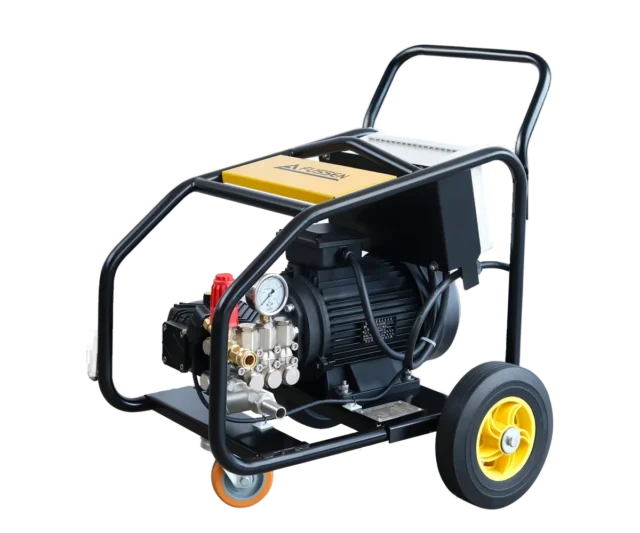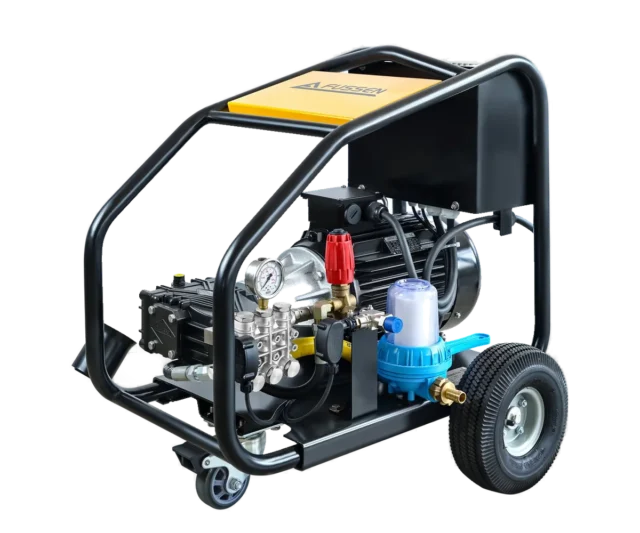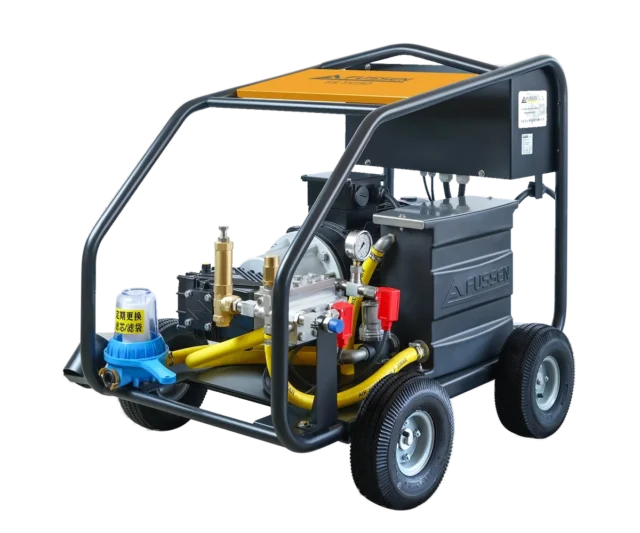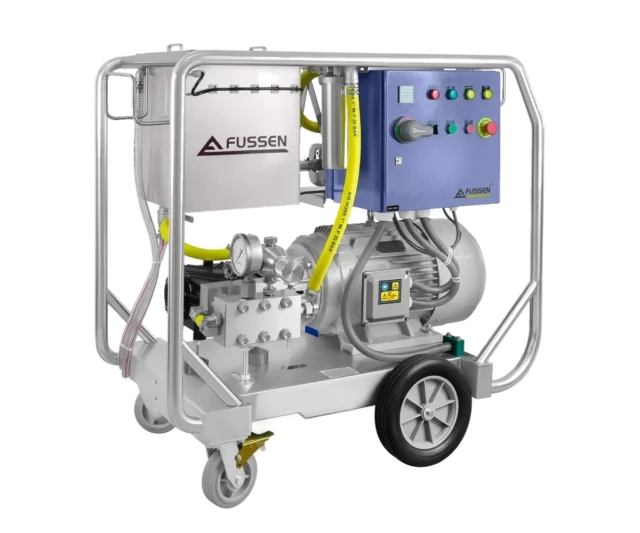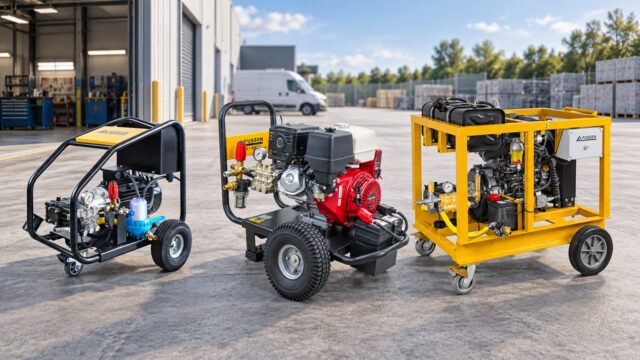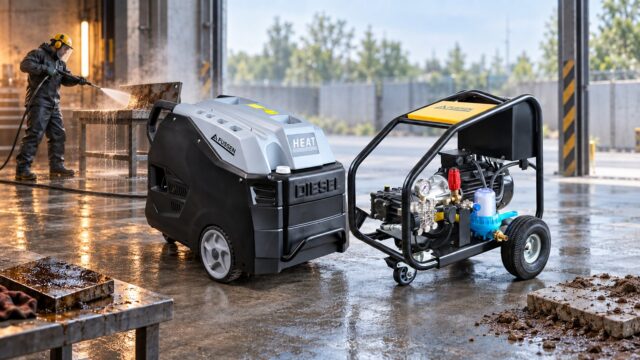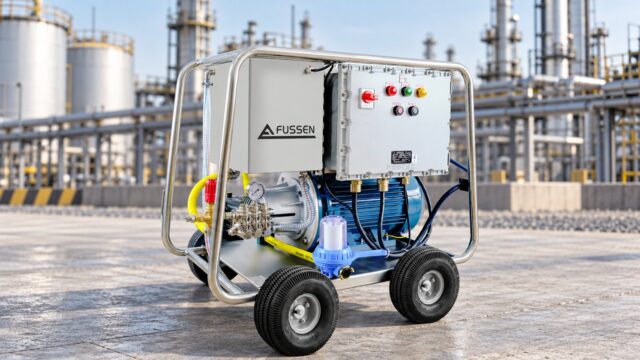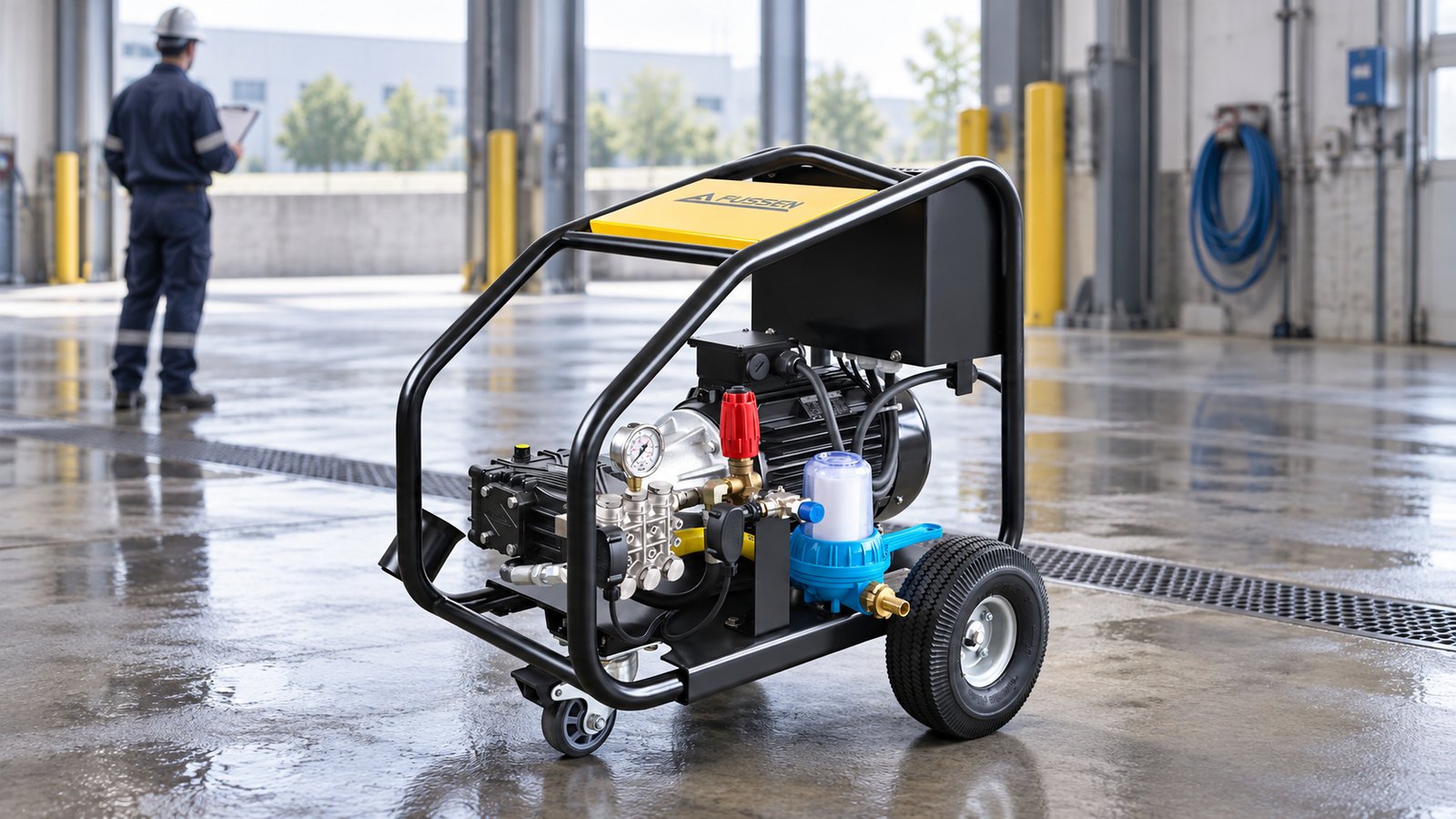
Select a pressure washer by the cleaning task, available power and water conditions. Pressure and flow must be checked together at the required operating point.
Start with the surface and soil
Record the material being cleaned, the deposit, the required finish and whether existing paint must remain. No single pressure is safe for every painted surface: nozzle pattern, distance, angle and dwell time also affect damage. Follow the surface supplier's instructions and establish settings on a representative test area.
Pressure helps break the bond; flow carries loosened material away. Their product indicates hydraulic power, not a guaranteed cleaning rate. For a large area, compare complete nozzle arrangements and measured productivity rather than choosing the highest bar rating.
Calculate three different power values
Hydraulic power: Pₕ (kW) = p (bar) × Q (L/min) ÷ 600. Required pump shaft power is Pₕ ÷ η, where η is pump overall efficiency at that duty. Electrical input also includes motor and drive losses. Use confirmed efficiency data for final selection.
At 300 bar and 15 L/min, hydraulic power is 7.5 kW. Assuming η = 0.88, the pump requires about 8.52 kW at the shaft, before any additional transmission loss. Select a motor for the full operating envelope, starting conditions and duty rating.
At 150 bar and 12 L/min, hydraulic power alone is 3.0 kW; a 3 kW motor cannot deliver that point with real pump losses. A 3 kW shaft input at η = 0.88 corresponds to about 10.56 L/min at 150 bar.
Confirm the actual electrical supply
Single-phase or three-phase supply is a site constraint, not a universal power limit. Confirm voltage, frequency, available current, starting method, cable protection and the machine's rated input. A socket current rating by itself does not establish which motor can start and run reliably.
Match every wetted component to the water
Clean fresh water may suit a brass head. Nickel-plated brass or stainless steel may be appropriate for other duties, but the exact grade, chemical concentration, temperature and seal compatibility must be checked. Stainless steel is not immune to seawater corrosion; pH alone is not a sufficient selection rule.
Confirm the actual plunger material and seal specification for the model. Do not assume that all pumps in a range have the same ceramic construction or temperature limit.
Check the complete pressure circuit
The hose assembly, connectors, gun, nozzle and valves must all suit the maximum permitted system pressure, temperature and medium. Burst pressure is not an operating allowance. Use the applicable assembly ratings and inspection requirements rather than a universal safety multiplier.
Choose a frame and handling arrangement suitable for the site's loads and access. A reel can reduce hose dragging and kinking, but it does not guarantee a particular service life.
Compare ownership costs
Estimate energy from average electrical input and operating hours, not simply the motor's shaft rating. Include water, detergent, maintenance, labour and downtime. Keep assumed productivity separate from measured results. Send the proposed operating point, supply details and water analysis for model-specific selection.
Related equipment
References and product documents
BSSA: stainless steel in seawater
Frequently asked questions
Is pressure more important than flow?
Both matter. Establish the pressure and nozzle conditions needed to remove the deposit, then assess the flow and coverage required for the job. Hydraulic power alone does not predict cleaning speed.
Can 3 kW provide 150 bar at 12 L/min?
No, not as shaft power with real pump losses. That point already needs 3.0 kW of hydraulic output, about 3.41 kW at the shaft if pump efficiency is 0.88, and more electrical input.
Is stainless steel always suitable for seawater?
No. Confirm the grade and the suitability of all wetted components for the chloride level, temperature and exposure conditions.

Fussen has designed and manufactured high pressure plunger pumps and industrial washers in Foshan, China since 2001. ISO 9001 / 14001 / 45001, CE and ATEX-certified, exporting to more than 60 countries.